
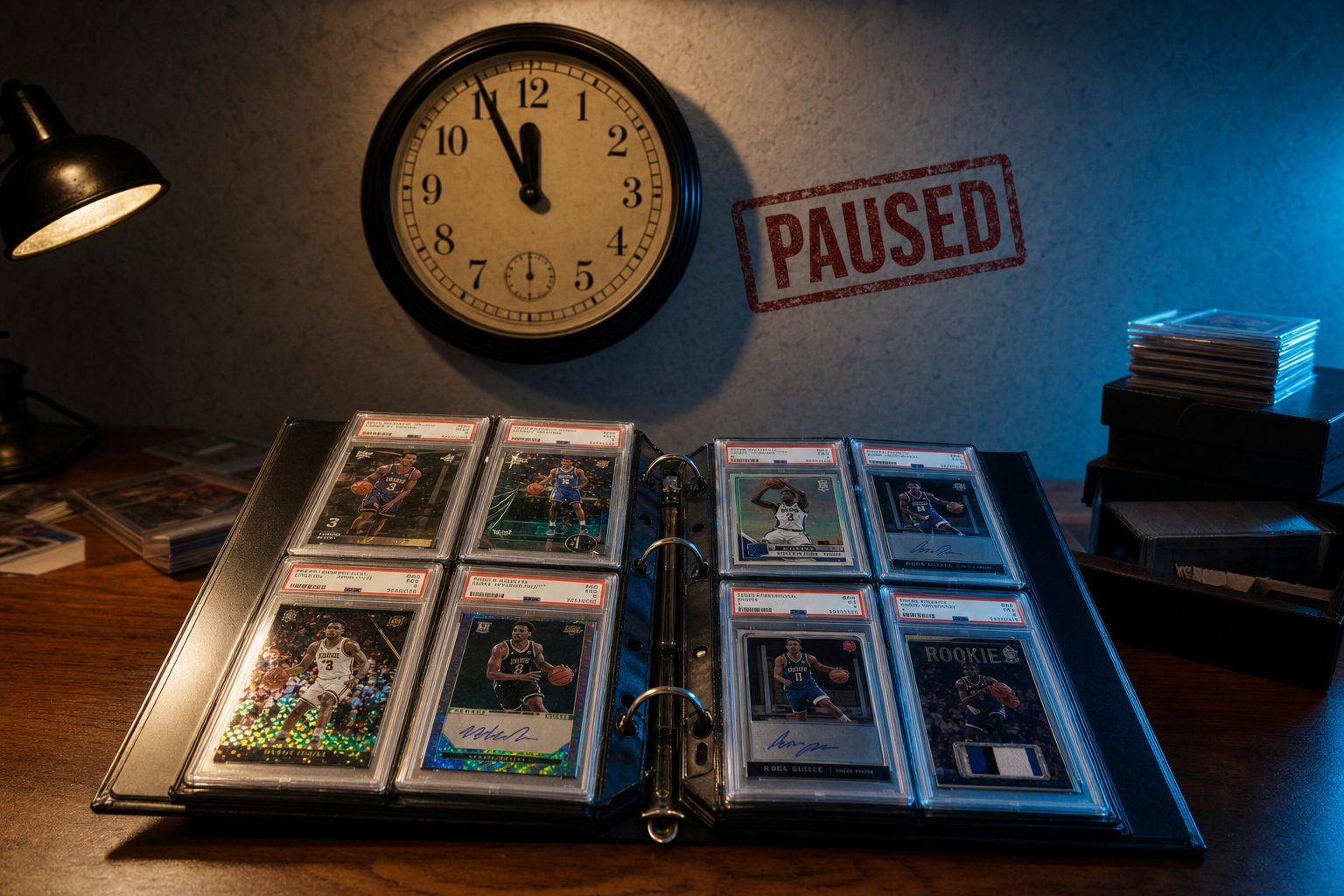
You have until June 2, 2026. That's the PSA submission deadline for all four Value grading tiers — Value Bulk, Value, Value Plus, and Value Max. After that date, the PSA Value tier shutdown goes into effect and new submissions are closed until further notice. If you're selling at card shows this summer — or planning to — this checklist covers every move to make between now and Monday.
For the full news and high-level context behind this pause, read the full breakdown of the PSA Value tier pause. This post is about what you actually do.
Step 1: Confirm the PSA Submission Cutoff Timing
The PSA Value tier shutdown applies to orders received on or after June 2, 2026 — not postmarked. That distinction matters if you're shipping. If your package doesn't arrive at PSA's facility by June 2, it won't be accepted under Value tier pricing.
What that means practically:
- If you're shipping standard ground from the Ohio Valley, that window is effectively already closed or closing today — ground transit is 2–3 business days minimum.
- Overnight or 2-day shipping (FedEx, UPS, USPS Priority Mail Express) are your last routes if you haven't shipped yet.
- Walk-in and on-site PSA submissions at card shows are governed by show-specific rules — confirm directly with PSA if a show is happening before June 2 in your area.
- Regular, Express, Super Express, and Walk-Through tiers are not affected by the PSA shut down — those remain open with extended turnaround times (Regular is now 40–50 days).
Action: Log into your PSA collector account now, confirm any pending orders are submitted, and check tracking on anything already shipped.
Step 2: Which Cards to Prioritize for Grading Right Now vs. Hold
Not every raw card deserves a last-minute Value submission. The math has to work. The framework I use: submit when the PSA 9-to-10 value gap exceeds the grading cost by a meaningful margin. The gap has to justify the risk of landing an 8.
Cards worth prioritizing for a last-chance submission:
- Modern refractors with significant grade premiums — I focus on '90s and early 2000s refractors (Topps Chrome, Finest, Bowman Chrome), plus vintage Jordan, Kobe, Shaq rookies. These are cards where the PSA 9 vs. PSA 10 spread on Card Ladder is wide enough to make grading cost trivially small by comparison.
- High-population cards where a 10 still carries a premium — check Card Ladder's pop report context alongside recent sales. High pop doesn't always kill the 9-to-10 gap on in-demand cards.
- Cards you already know grade well — centered, sharp corners, clean surfaces. Don't burn a submission slot on a borderline card under deadline pressure.
Cards to hold back:
- Raw cards where the PSA 9 and PSA 10 prices on Card Ladder are close — grading cost eats the margin.
- Cards you'd send SGC or BGS anyway (see Step 5 below).
- Low-value bulk that you were submitting just to have it slabbed — those economics don't hold at Regular or Express pricing. Better to sell raw or hold until Value tiers reopen.
- Anything with visible surface wear, print lines, or centering issues. Don't chase an 8.
Step 3: Run Your Inventory Audit
Before the PSA submission deadline hits, take 30 minutes to count what you actually have. This pays off at every show this summer.
Inventory audit checklist:
- Count total raw cards by category — sport (basketball, baseball, football), set family (Chrome refractors, vintage, modern base), and rough condition tier (near-mint raw vs. played).
- Count existing PSA slabs by grade — separate your PSA 10s, PSA 9s, and PSA 8-and-below. These are your summer premium inventory. Know your numbers going into every show.
- Flag raw cards for the last-chance submission — pull the candidates from Step 2 into a separate pile. Decide today: submit, hold, or sell raw.
- Count non-PSA slabs separately — BGS, SGC, HGA. Know which graded cards you have by grading company. Buyers will start asking more questions about alternatives this summer.
- Note which sets are completely raw — if you have zero slabbed cards from a popular set and all your inventory is raw, that's a pricing and display strategy decision for shows.
You don't need a spreadsheet (though it helps). Even a rough count per box gives you a working picture heading into a summer where graded supply is going to tighten.
Step 4: Card Show Pricing Strategy — Mark Up Existing PSA Slabs
Here's the market dynamic: with the PSA Value tier shutdown in effect, the pipeline of freshly graded cards coming to market is going to thin out significantly through summer. Bulk submitters — who feed a constant stream of slabbed modern into the market — are sidelined. That tightens supply on existing inventory.
How to approach slab pricing for summer shows:
- Check Card Ladder before every show — use recent 30-day sales as your baseline, not 90-day. The PSA shutdown will start moving prices on high-demand slabs within weeks. Stale comps will leave money on the table.
- Price PSA 9s and 10s on desirable modern refractors with a scarcity premium — you can justify it. Buyers who want slabbed cards for show display, resale, or grading comparison have fewer options now.
- Don't over-correct on lower-grade PSA slabs (8 and below) — the shutdown mostly squeezes supply of 9s and 10s. PSA 8s and below have thinner demand and the shutdown doesn't meaningfully change their market.
- Be transparent with buyers — telling a buyer "PSA Value tiers are shut down for the summer, so new slabbed supply is limited" is a legitimate sales point, not a sales pitch. It's accurate and it explains your pricing.
- Display slabs front-and-center in your case — this is not the summer to bury slabbed cards behind raw inventory. Your slabs are your premium, lead with them.
Step 5: Should You Switch to SGC or BGS for the Summer?
Short answer: for specific cards, yes — and it's worth understanding both options before the PSA submission deadline passes.
SGC
SGC has historically offered faster turnaround than PSA Value tiers even in normal times. With the PSA shut down, demand at SGC will spike — but SGC has less of a backlog problem heading into the summer. If you have cards where a fast turnaround matters more than the PSA label premium, SGC is the right call. SGC vintage holds value well; the gap between SGC and PSA is narrower on pre-war and 1950s–70s cards than it is on modern. For the full grading company comparison, see PSA vs BGS vs SGC — which grading company should you use in 2026.
BGS (Beckett)
BGS Premium tier is worth considering for high-value modern cards where the sub-grades add meaningful information (centering, corners, edges, surface scored separately). BGS Black Labels carry real premiums on certain cards. The tradeoff: BGS is slower and pricier than SGC, and BGS labels on modern don't command the PSA premium with most buyers. Use BGS when sub-grades actually matter to your buyer — usually serious registry collectors or buyers chasing BGS 9.5s and 10s on specific cards.
The honest take
For most card show sellers in the Ohio Valley, the summer pivot to SGC makes more sense than BGS for bread-and-butter inventory. Reserve BGS for your best pieces where sub-grades add real value documentation. And keep watching Card Ladder — if SGC sales start trending up on cards you're holding raw, that's your signal.
Step 6: Raw Card Market Expectations Through Summer
The PSA Value tier shutdown removes a major demand driver for raw modern cards: the bulk submitter. A significant portion of show-floor raw buying is done by dealers and flippers who are buying specifically to submit Value Bulk. With that closed, raw modern demand is going to soften.
What to expect:
- Raw modern base cards and common refractors will soften — price them to move now. Buyers know they can't profitably grade them through summer, so they'll lowball or skip.
- Raw vintage is mostly unaffected — vintage goes Regular or Express anyway. The PSA shut down hits Value tier, not the tiers vintage collectors use.
- Raw star cards and key rookies hold up better — the '90s Chrome refractors, vintage Jordans, Kobes, Shaqs — buyers will still pay for these raw because the long-term grading case still exists and the card itself has value ungraded.
- Set your raw pricing based on Card Ladder's raw sale comps, not graded comps minus a mental discount. Check actual raw sale data where available.
- Be ready to hold raw modern through the summer if prices soften more than you expect. Don't chase buyers down on low-value raw — the juice isn't worth the squeeze at a show.
Step 7: Pre-Show Checklist — What to Bring This Summer
With the PSA submission deadline behind us and the summer show circuit ahead, here's the practical box-packing list for any card show through fall 2026.
Inventory
- All PSA slabs — front of case, priced with Card Ladder comps from the past 30 days
- SGC and BGS slabs labeled clearly by grading company
- Raw star cards and vintage — organized by sport/player
- Raw modern inventory priced to move, not priced to grade
Supplies
- Penny sleeves (bring more than you think)
- Top-loaders in multiple sizes (standard, thick card, screwdown for your highest-value raw)
- Semi-rigid card savers for transport
- Slab stands or display risers — your PSA slabs need to be visible
- Bubble mailers and packing supplies if you're doing deals that need to be shipped later
Pricing reference
- Card Ladder pulled up on your phone — this is non-negotiable. If a buyer questions your price, show them the data. If you're not sure what to charge, check it before they walk up.
- Know your floor prices ahead of time so you're not calculating margins mid-conversation at the table.
Payment methods
- Cash — always
- Venmo and PayPal (goods-and-services for anything meaningful)
- Square or similar card reader for credit/debit
- Zelle if you're comfortable with it for known buyers
Know your talking points
- PSA Value tiers are shut down through at least September — slabs are in limited supply
- SGC is the active alternative for anyone looking to grade this summer
- Card Ladder is your reference — you're priced to market, not to vibes
The Bottom Line
The PSA Value tier shutdown is a real market event, not just a hobby headline. Sellers who treat it as a tactical opportunity — move last-minute submissions, tighten slab pricing, soften raw modern expectations, and show up to summer card shows with a clean inventory count and Card Ladder on their phone — are going to have a strong run through September.
I'll be at shows across the Ohio Valley all summer. Check the 2026 card show schedule to see where I'll be set up. If you've got questions about specific cards — whether to submit, hold, or move raw — come find me at the table or drop a comment on the channel.
— John